

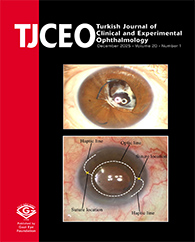

Methods: This retrospective study included eyes with XFG undergoing combined Phaco-BANG. Preoperative and postoperative intraocular pressure (IOP), number of antiglaucoma medications, visual acuity, surgical success, and complications were analyzed. Complete success was defined as IOP ≤21 mmHg with ≥20% reduction without medication, and qualified success as the same IOP target with or without medication. Mean IOP and medication changes were compared using paired statistical tests, and Kaplan–Meier analysis was used to estimate survival probability.
Results: Thirty-eight eyes of 38 patients were included. Mean preoperative IOP decreased from 33.6 ± 4.1 mmHg to 17.0 ± 3.9 mmHg at 12 months (49% reduction, p < 0.001). The mean number of medications reduced from 3.1 ± 0.4 to 0.4 ± 0.8 (p < 0.001). Complete and qualified success rates were 71.1% and 97.4%, respectively, at 12 months. Transient hyphema occurred in 13 eyes (34.2%), resolving spontaneously, while early IOP spike occurred in 2 eyes (5.3%) and hypotony secondary to cyclodialysis cleft in 1 eye (2.6%); no sight-threatening complications were observed.
Conclusion: Phaco-BANG provides a safe, cost-effective, and implant-free minimally invasive glaucoma surgery achieving substantial IOP and medication reduction in XFG. The results compare favorably with other combined phaco-MIGS techniques, suggesting Phaco- BANG as a valuable alternative for resource-limited settings.
Keywords : Bent Ab Interno Needle Goniectomy; cataract surgery; minimally invasive glaucoma surgery; phacoemulsification;